You Have More Marketing Options Than Instagram.
I need you to know something wicked important: Instagram is one option. It is not the only option.
I know that sounds obvious. It also runs against pretty much everything marketing people will tell you, so I figure it's worth leading with.
Some independent practices love instagram and grow real businesses from it. I’ve grown businesses with socials, so I’m not saying it isn’t possible. Some run a simple, little facebook page with their hours and a phone number and stay booked out three months in advance. Some do email and SEO and basically nothing on social. Some run google ads and skip the content game entirely. All of those are real, legitimate marketing strategies. The trick is picking the one that fits your practice, your patients, and the energy you have for it.
First, decide what social is for in your business.
If you're on instagram or facebook, you have three options for what that presence is doing.
information mode. Your social is there so patients can confirm you exist, find your hours, see your address, and know the practice legitimate. Low effort. Update it monthly. Pin your address and contact info. Done.
maintenance and relationship. You're showing up regularly to stay in touch with your existing patients and community. A post a week or two. A reel when you feel like it. Photos of the practice, your team, the occasional educational note. Medium effort. Keeps you visible without taking over your life.
growth. You're using social to bring in new patients who don't know you yet. This is high effort. It means knowing exactly who you're talking to, writing in their language, understanding what makes them choose, and showing up enough that the algorithm takes you seriously.
Pick the mode that fits your vibe, then look at what else is in the mix.
Beyond social, you have a bunch of other marketing channels worth knowing about. Most independent practices use some combination of these. Some lean heavily on one or two and skip the rest.
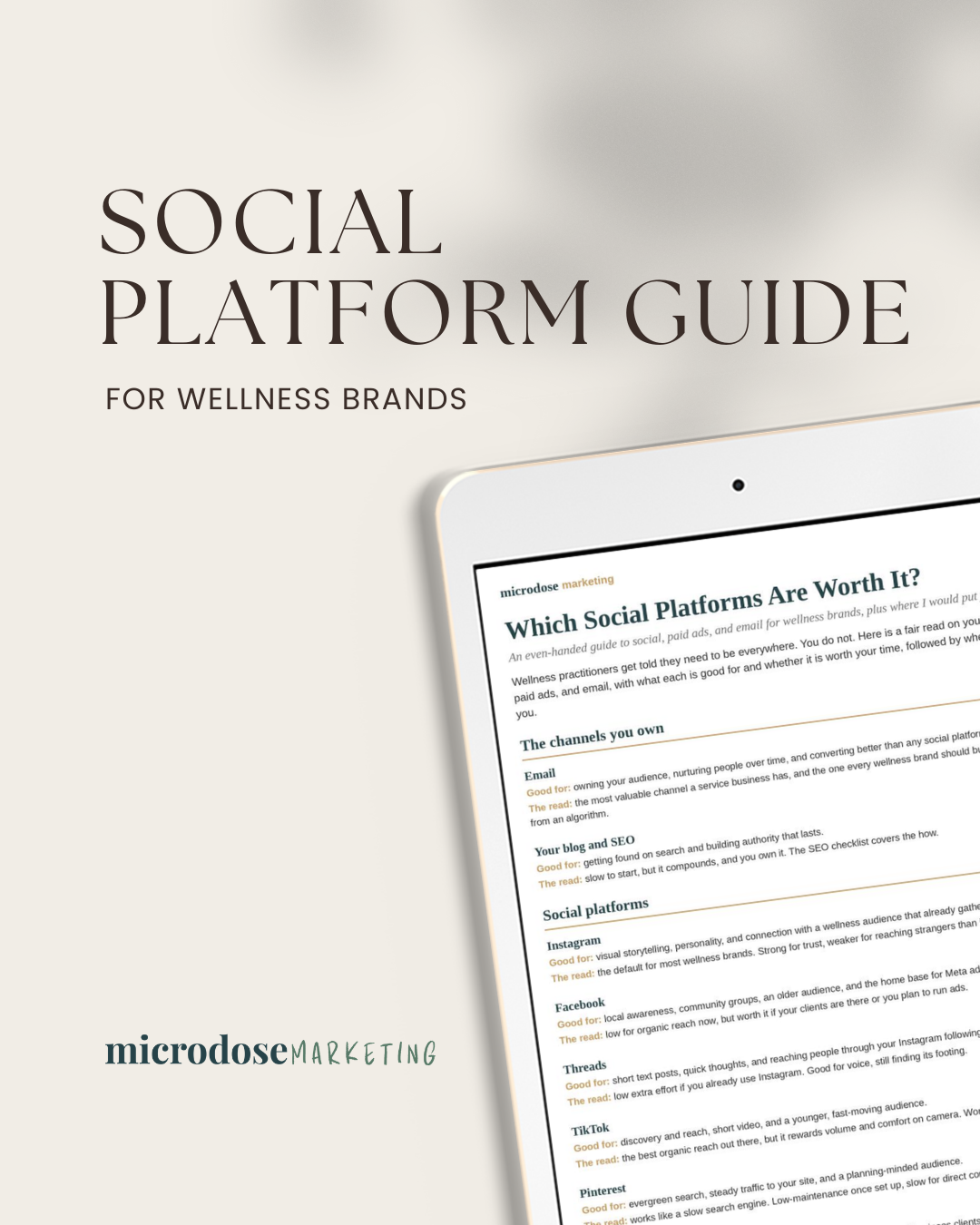
An honest read on every platform, and where to actually focus.
You don't need to be everywhere. This free guide gives a fair, platform-by-platform read on Instagram, Facebook, Threads, TikTok, Pinterest, LinkedIn, YouTube, and Substack, then my honest take on where a non-ecommerce wellness brand should actually spend its energy.
Your website is the foundation. Period.It has to tell a patient what you do, who you do it for, what it costs, and what to do next, ideally above the scroll. Most practice websites are designed to confirm credentials. If yours is doing that and nothing more, it's the first place to look.
Local SEO does a lot of quiet work. Showing up when people in your area search for what you offer. Google Business Profile claimed and optimized. Real photos. Real hours. Reviews coming in regularly. This runs in the background while you're doing other things.
Email is the most underrated marketing channel in independent practice. A small list of people who chose to hear from you is worth more than thousands of followers who didn't. (We can debate this. I will win.) You can run a whole practice on a website, a Google Business Profile, and a thoughtful email list of 200 people.
Referrals are still the highest-converting channel in healthcare. From other providers, from happy patients, from people in your community who know you and tell other people. Slow, boring, and ridiculously effective.
Paid ads when the market supports it. Google Ads especially, since the people clicking are searching with intent. Worth testing if you're in a city with patient demand and a $500 monthly budget to start.
Most practices need maybe two or three of these working well. Not all of them. Not even close.
A few questions...
What's currently bringing you patients? Look at the last 20 new patients. Where did they really come from? You'll probably notice a pattern, and that's worth paying attention to.
What's currently draining your energy? If instagram is taking five hours a week and bringing you one inquiry a year, it might still be worth it for the relationship piece. Or it might not.
What feels sustainable? Marketing only works if you can keep doing it. A small list of channels you can maintain will outperform a drawn out strategy you abandon every six weeks.
The point.
You have options. Real ones. Instagram is one of them. There are several others. Some practices use a lot of them. Some use one or two and ignore the rest entirely. Get the free social media platform guide for wellness brands here
There is no rule that says you have to be on every platform, posting every day, in order to have a successful practice. The rule is that you have to be doing something, somewhere, that's working for the kind of practice you're trying to build.
If you want help figuring out what that looks like for you, that's exactly what a consultation call is for.